
In response to an aging population and the growing demand for long-term care, Taiwan is revamping its system to bring care back into local neighborhoods, rebuilding the supportive networks that connect people with one another. From the shift toward Long-Term Care 3.0 to the promotion of the Compassionate Community initiative, the idea of a "symbiotic community" is more than just a policy blueprint. It is a vision for a way of life in which living well and dying with dignity can happen at the same time.
Late at night, the hospital room light is still on.
A senior in his 70s sits by the bedside, repeatedly asking the same question: "When I go home, who is going to take care of me?" The nurse standing nearby knows that his physical condition has stabilized and, in principle, he is ready to be discharged, yet no one feels confident making that final decision.
His wife is even older, his children work in other cities, and the family has neither a suitable environment for caregiving nor a reliable caregiver. Medical care can treat an illness, but it cannot solve the realities of everyday life after a person returns home. Scenes like this are all too common in Taiwan's hospitals.
When Medical Treatment Ends, Who Takes Over Daily Care?
According to statistics from the Ministry of Health and Welfare, the average life expectancy in Taiwan has surpassed 80 years, but the average period of unhealthy life expectancy ranges from 7.5 to 8.5 years. In other words, there is a significant gap between the years a person can move about freely and their actual life expectancy.
In recent years, more and more seniors are not suffering from acute illnesses, but are instead living for extended periods between chronic illness and physical frailty—a prolonged period of "living with illness." There is no clear endpoint. Instead, during the final year of life, many repeatedly move back and forth between hospitals and home, with daily life and caregiving becoming deeply intertwined.
When caregiving is no longer a brief medical process but an ongoing condition embedded in everyday life, the once-clear boundaries begin to blur. Hospitals cannot take on a person's daily life indefinitely, and care facilities cannot replace a familiar environment. This raises the questions: Where should a person be cared for? And who will care for them?
"The community must be the most important setting for daily life; ultimately, all care needs to return here," says Jen-Der Lue, Deputy Minister of Health and Welfare. Over the past decade or more, Taiwan's long-term care policies have gradually built a system centered on service provision: home care, day-care centers, and residential placement, each addressing different needs at different stages of aging. However, in the planning of Long-Term Care 3.0, there has been a key shift in perspective.
Compared with the past focus on care after a person becomes disabled, Long-Term Care 3.0 extends its reach further upstream, placing "prevention" and "delaying disability" at the center. The setting for this transformation is no longer simply medical institutions, but the place people know best: their own communities.
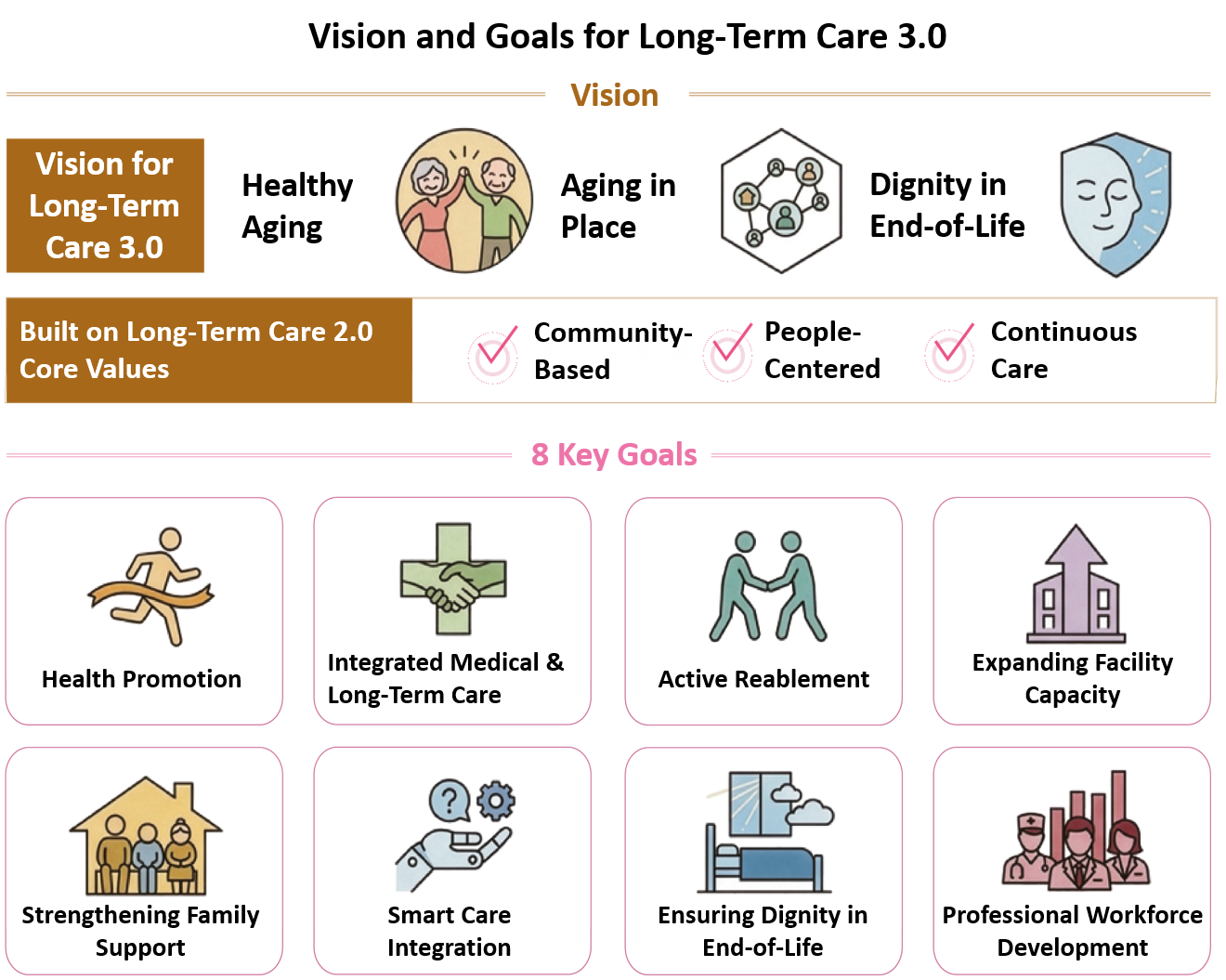
The Shift to Long-Term Care 3.0: Bringing Care Back to Everyday Life
"Local care stations are like distribution channels. Once the points are established, care has a real chance to enter people's daily lives," Lue says. Over the next eight years, the goal is to establish "one care station per village or neighborhood" across Taiwan's more than 7,000 villages and neighborhoods, reconnecting them into a comprehensive care network.
He adds that these local care stations initially focused mainly on activities such as shared meals and health promotion. Today, however, they are being repositioned as key nodes in the care network. Faced with rapidly rising care needs and a shortage of caregivers, residents will be able to access basic care support within a 30-minute driving radius of where they live.
The core spirit of Long-Term Care 3.0 is "symbiosis." Different groups with different needs—including seniors with disabilities, people with physical or mental disabilities, and even people with psychiatric conditions—can share the same care station space. At the same time, smart assistive devices, caregiving robots, and automated bathing equipment can help reduce the pressure of one-to-many caregiving.
Lue also highlights the concept of "reablement," that is, no longer viewing older adults simply as recipients of care, but helping them maintain their abilities, participate in daily life, and even regain the ability to care for others. New measures launched this year, such as the "Family Caregiver Co-Prosperity Circle," adopt a concept similar to a time bank. Multiple families share the same care station, while the government provides one full-time professional caregiver and family members take turns serving as volunteers. This allows families to find a balance between caregiving and respite, while also allowing care to circulate within the community rather than remaining the burden of individual families.
This shift also extends to end-of-life preparation. Lue points out that the government has allocated funds to subsidize Advance Care Planning (ACP) consultations for specific groups, prioritizing middle-aged and older adults or patients with severe illnesses. At the same time, spiritual care courses from Germany have been introduced at certain care stations to help seniors organize their life experiences and face both relationships and mortality.
From Dying Well to Living Well: Caring for One Another Starts in the Community
"We aren't just talking about hospice; we are looking at the entire state of living through the lens of 'palliative care,'" says Dr. Ying-Wei Wang, a current board member of the Hospice Foundation of Taiwan and Director of the Palliative Medicine Center at Hualien Tzu Chi Hospital. This is also the reason he has spent years promoting "Compassionate Communities."
A "Compassionate Community" is not a new service model; it is more like a reimagining of relationships within a community. Centered on the person who needs care, it radiates outward in concentric circles of support: family, neighbors, friends, and even the wider community. These relationships exist within everyday life and can become active sources of support when needed.
Dr. Wang observes that many older adults still live in familiar communities. During the day, they may go out to buy groceries or sit for a while at the corner of their street. Yet, as their bodies gradually become weaker, the first thing to disappear is often not their ability to move, but their connection with other people. Once they stop going out for several days without anyone noticing, or an accident happens at home without being discovered in time, someone who could have continued living in the community may ultimately be forced to leave their familiar surroundings.
Dr. Wang admits that Taiwan does not yet have a "typical" Compassionate Community. Most efforts are still in the stage of experimentation and gradual accumulation of experience. Yet, in reality, everyone has the ability to become part of the care network. A familiar shopkeeper might pay closer attention to an older person living alone; a neighbor might accompany them to a medical appointment; someone skilled at home repairs might install fall-prevention grab bars for an older adult; or someone might simply help care for a household pet or walk alongside a person for part of the way. These seemingly small actions can become key conditions that allow people to continue living in their communities.
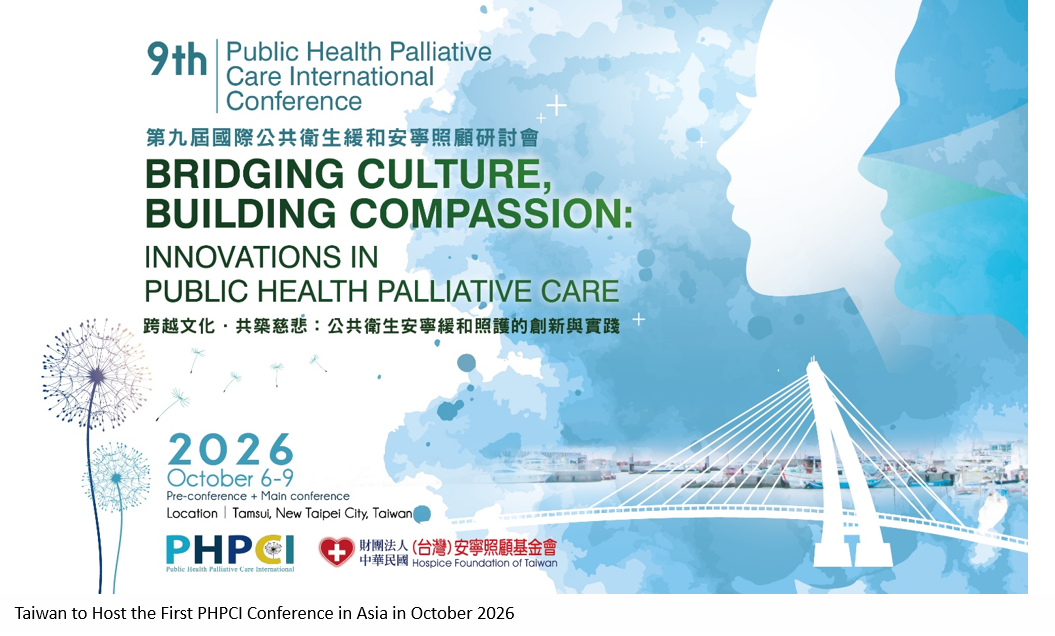
PHPCI Hosts First Asian Conference: Letting End-of-Life Care Grow in Communities
In recent years, this philosophy has also been promoted through international initiatives. PHPCI (Public Health Palliative Care International) approaches end-of-life care from a public health perspective, emphasizing the role of the community in caring for people at the end of life. It seeks to transform "dying well" from a medical issue into a life issue that society as a whole faces together, so that every person can be well accompanied during the final stretch of life, while those experiencing grief after a loss can also find support within the community and gradually emerge from the shadows.
Dr. Wang points out that this October, the PHPCI Annual Conference will be held in Asia for the first time, with Taiwan chosen as the host location. This is more than simply an international exchange event. It is also an opportunity to move the concept of "Compassionate Communities" from discussion and advocacy into more concrete local practices. The conference will connect healthcare, social welfare, communities, and civic organizations through forums and activities, creating opportunities for different groups to see one another and discover more possibilities for where and how care can happen.
In Taiwan, the "symbiotic community" is still taking shape in its own unique way. From Long-Term Care 3.0 to the transformation of local care stations, the government is trying to weave scattered services into a care network that is more closely connected to daily life. Yet, what truly allows this network to work still depends on the connections and understanding between people beyond the formal system, allowing symbiotic communities to truly take root and flourish.
Perhaps, when a person can no longer live independently, there will still be someone by their side who is willing to stay.
That is the answer the symbiotic community is ultimately seeking.