
Even as the care system becomes increasingly comprehensive, gaps in care inevitably remain. In Wenshan, Taipei; Dongshi, Taichung; and Chingliu, Nantou, three co-living care homes each respond in their own way to the same question: As people grow old, can they be held and supported within relationships, and continue to live their lives?
As Taiwan’s long-term care system has developed, institutional care and home care services have gradually established the basic framework of caregiving. Yet, between the two, there remains a gap that is difficult to fill. Families who are unwilling or unable to enter institutions, but also find it difficult to rely entirely on home care services, often have no choice but to struggle to keep things going.
It is precisely within this gap that co-living care homes have slowly emerged as another possibility. They are not alternatives outside the formal system, but an extension that is closer to everyday life, bringing care back to the people and relationships at its heart.
Wenshan Co-living Care Home
Rebuilding a "Home" at the Boundaries of the System
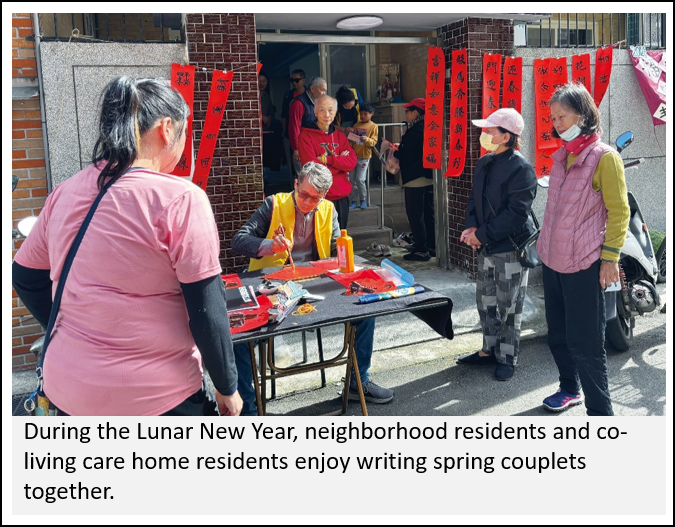
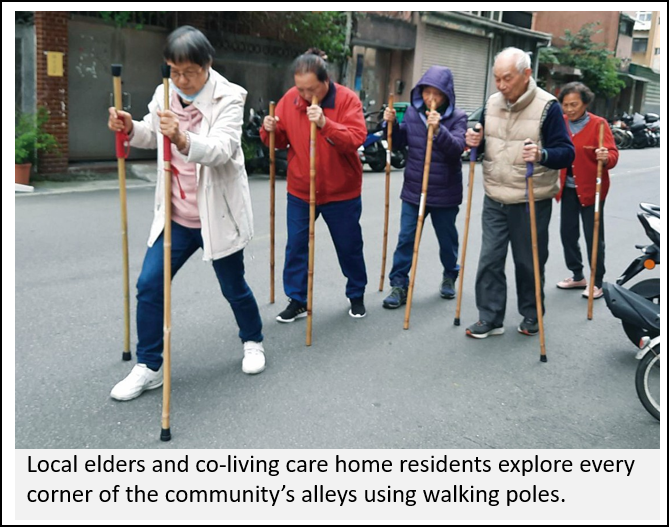
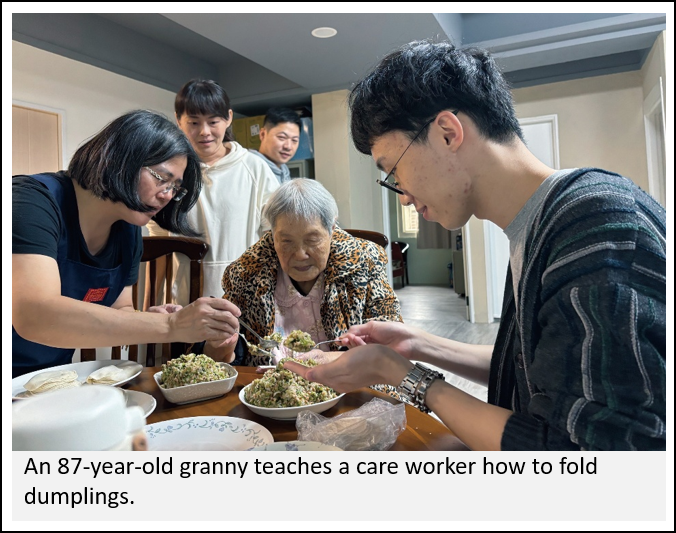 In a quiet alley in Wenshan, Taipei, an old house with a garden and plenty of sunlight has been given new life. A group of people who need care live here. Some are recovering from illness, while others have difficulty moving around. Yet, within this space, there is no such thing as a "care recipient." Instead, everyone contributes according to the physical abilities they still have. Some prepare meals, while others greet visitors. It feels less like an institution and more like a family that supports one another.
However, this space did not begin with an idealistic vision. It grew out of disappointment with and questions about the existing system. Mei-Chu Lin, a board member of the Bliss and Wisdom Charitable Foundation who was involved in developing the Wenshan Co-Living Care Home from the beginning, has spent her career across the medical and social welfare systems. From working as a psychiatric social worker to managing a large-scale senior care institution, she spent many years working within the system and therefore came to see its boundaries even more clearly.
"The essence of an institution is management, making sure that risks do not occur." Lin once oversaw the care of 300 seniors in a long-term care institution. Yet even with sufficient staff and a complete system, residents' movements were restricted to prevent falls. There were not enough staff to wake residents and take them to the bathroom every two hours, so diapers became the solution. For the sake of efficiency, residents were often fed even when they were still capable of eating on their own.
"It became a place of wheelchair culture, diaper culture, and feeding culture. It wasn't that the staff were unwilling to care; it was that the system left them with no other choice."
"This kind of care is certainly safe, but it also causes people to lose what it means to be human." During her first three months on the job, Lin says she cried almost every night in the darkness. "The seniors' daily needs were well cared for, but we couldn't see smiles on their faces. There was no joy or dignity. Everyone felt that coming here simply meant waiting to die."
One House, Making "Symbiosis" a Daily Reality
"What would it look like if care could return to everyday life? If a person could still retain a role and dignity while receiving support?" Years later, when Lin encountered the concept of co-living care homes, her question to the system finally found an answer.
"I hardly hesitated before getting involved," Lin says with a smile. Although she was only one step away from making her dream a reality, that one step took her more than half a year. "The biggest difficulty was finding a house."
She spent three months searching for a suitable space in Taipei. The properties were either too small, too expensive, or lacked an elevator. Just when she was almost out of options, a twist of fate led her to this house in Wenshan. "The moment I first stepped inside and saw the garden, the sunlight, and the open, airy layout of the rooms, I immediately knew this was the place!"
"A co-living care home is not a miniature version of an institution, but a practice of living together." Whenever a new "family member" moves in, Lin patiently explains that the space here is shared and relationships are equal. "The relationship between the caregiver and the care recipient is not hierarchical. We need one another, and we support one another."
This change is not limited to the level of ideas; it truly happens in people's lives. The story of "Chief Yeh" unfolded in just such an everyday setting.
When Chief Yeh first came to the Wenshan Co-Living Care Home, neither his physical condition nor his overall state was stable. He had suffered several nearly fatal injuries, and his movements had become slow and difficult. Yet, compared with his physical limitations, his guardedness toward other people was the greatest challenge to his initial adjustment to the co-living care home. He once thought that he had "been sent to another institution," and therefore strongly resisted being "placed" there.
During that period, he spoke little and rarely interacted with others. The change came in a seemingly ordinary moment. During an activity, someone needed to call out the rhythm, but the room remained quiet, and no one was willing to speak up.

At that moment, Chief Yeh stepped forward and took on the role. With a strong, resonant voice and full of energy, he led everyone.
"From that day on, I started calling him 'Chief,'" Lin says with a smile. The name unexpectedly touched the part of Yeh that longed to interact with others. Today, at the Wenshan Co-Living Care Home, Chief Yeh is no longer simply someone receiving care; he is someone who takes the lead. From his earlier withdrawn and unsettled state, he has gradually become willing to participate in all kinds of details of everyday life.
"A nickname redefined his position in this space and helped him find himself again," Lin says. To date, the Wenshan Co-Living Care Home has welcomed more than ten "family members." Some voluntarily help wash the dishes, some are responsible for opening the door and welcoming visitors, and some notice when a visitor might need a cup of tea. "These seemingly small actions all represent care recipients becoming people who once again have abilities and can contribute."
Dongshi Co-Living Care Home
When Someone Catches You, Care Is No Longer Something You Simply Have to Endure
If the Wenshan Co-Living Care Home answers the question of how "home" can be reconstructed, then the Dongshi Co-Living Care Home in Taichung takes the idea a step further, showing how a person or a family on the verge of no longer being able to cope can be firmly supported.
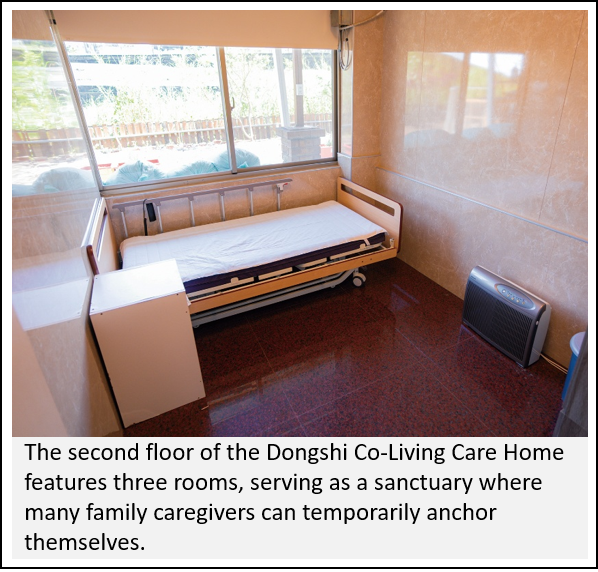
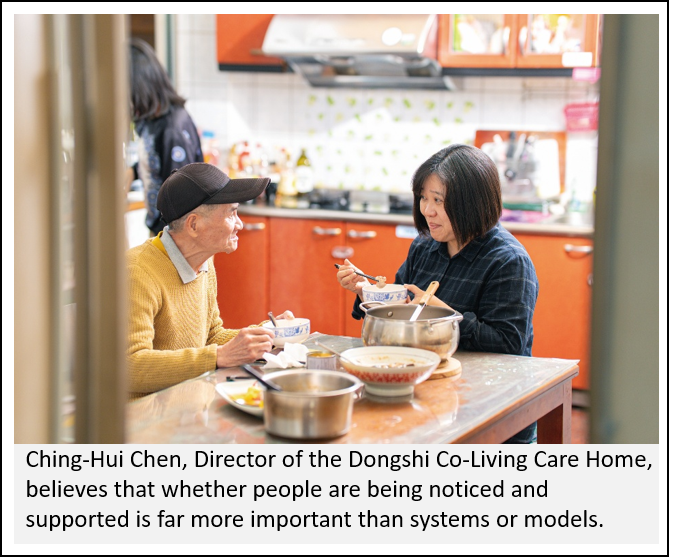 Following the slopes of the Dongshi mountain town, a renovated wooden house sits quietly. The space is quite simple: the first floor is a shared living area, while the second floor has several rooms for short-term stays. There are no clearly defined institutional boundaries here. Instead, it feels more like a home that continues to change as people come and go—a place willing to catch and support people when they need it.
"We are not trying to replace institutions, nor are we trying to replace Long-Term Care 2.0," explains Ching-Hui Chen, Director of the Dongshi Co-Living Care Home. Institutions provide structured and centralized care, while Long-Term Care 2.0 fills in the support provided through home services. Yet there is still a gap between the two. "Families who don't want to enter institutions, but cannot completely rely on one-on-one home care services, need an option that is closer to everyday life. A co-living care home is exactly suited to that need."
When Chen talks about the Dongshi Co-Living Care Home, she cares less about systems or models and more about "whether someone is being caught and supported." In her view, many caregiving difficulties are not simply caused by a lack of resources, but by the absence of somewhere to support a person when they can no longer manage on their own.
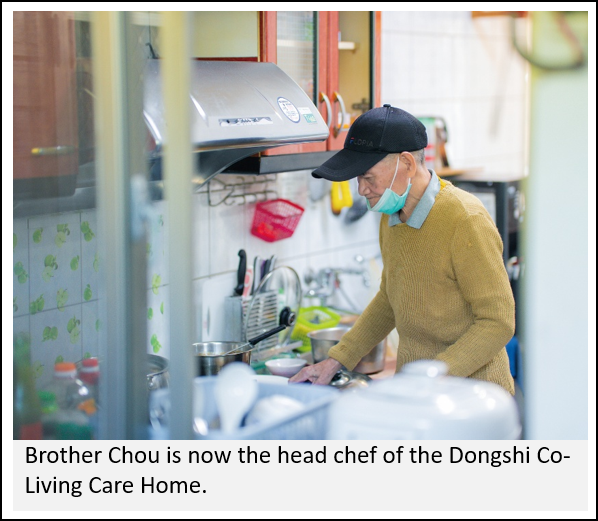
Take Brother Chou, who can often be found busy in the kitchen preparing lunch. All three daily meals at the Dongshi Co-Living Care Home come from his skilled hands.
"His blood sugar had been unstable for a long time, and he needed someone to care for him. Originally, his brother and sister-in-law were going to send him to a nursing home," Chen says with a smile. Who would have imagined that this soft-spoken man with a smile on his face once declared, "If you send me to an institution, then you'd better be prepared to come and collect my body!"
"This wasn't simply something he said in anger. It was a strong resistance to losing control over his own life." Chen recalls that when Brother Chou first arrived at the Dongshi Co-Living Care Home, both his emotions and physical condition were tense. Rather than rushing to place him into a care routine, they asked him, "What can you do? What can you do here?"
So he went into the kitchen and began helping prepare meals—from chopping vegetables and watching the stove to eventually managing the entire cooking process. Chen jokes that from the very first day Brother Chou moved in, he was not someone who needed to be cared for. "He's the person in charge of cooking in this home. If he takes a day off and goes home, we'll go hungry."
"When a person regains a role, their whole demeanor changes." Brother Chou, who once resisted every arrangement, now always wears a smile and has rediscovered his willingness to interact with others. "He helps us plan the menus for all three meals and writes the shopping list, then asks us to accompany him to the market to buy the ingredients." This is what a life of caring for and accompanying one another looks like.

At the Dongshi Co-Living Care Home, those who are supported are not only older adults, but also the caregivers who have spent long periods holding an entire household together. On the second floor, three rooms have been set aside as places where family members can temporarily stay and rest.
There was once a caregiver who came here when she was almost completely exhausted. She didn't say much. She simply went into a room, closed the door, and slept.
There were no cries in the middle of the night that she needed to respond to, and she did not have to keep her nerves constantly tense. That night, she was temporarily able to put down the responsibility of "having to take care of someone," and, after a long time, she finally had a good night's sleep.
"The next day, when she saw me, she hugged me and cried. She said it had been a very long time since she had slept so well." As Chen moves through the second-floor space, what she sees is more than bedsheets and duvet covers. She sees relief and understanding. "For her, this wasn't ordinary rest. It was a kind of lightness she hadn't experienced in a very long time, as if someone had helped take the weight from her shoulders."
Not Only Seniors—Caregivers Are Given a Place, Too
Chen admits that within the existing system, caregivers are often taken for granted. But here, they do not need to prove how hard they have worked, nor do they need to push themselves to the limit before anyone notices them. "They can temporarily let go, or even simply sit quietly."
At the Dongshi Co-Living Care Home, those who are supported are never only individuals; sometimes, it is an entire family. When four sisters came together to the Dongshi Co-Living Care Home, none of them had a smile on her face.
At first, out of filial devotion and a desire to share the responsibility with one another, they agreed to take turns caring for their sick father. But as time passed, exhaustion accumulated. The division of responsibilities became increasingly unbalanced. One felt she was carrying more of the burden, while another felt she was not being understood. The words remained unspoken, but the emotions slowly piled up. Caregiving, which had begun as an expression of love, became a source of tension.
 When they brought their father to the Dongshi Co-Living Care Home, they brought not only the challenge of caregiving, but also relationships that had already become strained. Chen saw what was happening, so she chose a gentle way to begin: "Let me be your little sister. We can take care of Dad together, okay?"
At that moment, the atmosphere began to lighten, and the places where things had become stuck slowly began to loosen. Chen's open and welcoming attitude allowed the caregivers to accept that bringing their father to the co-living care home was not an act of shirking their responsibility.
"When someone is willing to come in and carry the burden together, the breath of a family that was about to break can slowly be restored," Chen says with a smile. Today, when the sisters come, their interactions are filled with happiness. Even their father has gradually settled down and can openly say, "This is my second home."
Chen is no stranger to this kind of transformation, because she has walked a similar path herself. When she speaks about her mother-in-law, her voice is calm, but her words carry a sense of heartache. "After my mother-in-law moved into an institution, she began to deteriorate. She could still speak at first, but gradually became more and more silent. Eventually, she would even shout loudly at night, as if she were trapped inside a dark box."
 "During that period, it felt as though we could only watch helplessly as she moved farther and farther away from life." Later, Chen decided to bring her mother-in-law to the Dongshi Co-Living Care Home. As the way she was cared for changed, subtle changes gradually appeared. "Although her physical abilities did not completely recover, she began to recognize her family again, and her ability to speak slowly returned."
This experience further convinced Chen that when life is reduced to being cared for, arranged, and managed, a person's abilities also gradually disappear. "Therefore, what the Dongshi Co-Living Care Home truly wants to do is not only provide a place for care, but also give people the opportunity to return to life. We also hope that when families are about to reach the point where they can no longer hold on, we can be there to catch them."
Chingliu Tribe Co-Living Care Home
Growing Old Quietly on Familiar Soil
Wenshan and Dongshi show us the possibilities of "home" and of being "caught and supported." In the Chingliu Tribe of Nantou, the co-living care home goes one step further by answering another question: “Can a person remain rooted in the land they know, and grow old there in peace?”
At the Chingliu Tribe Co-Living Care Home in Ren'ai Township, Nantou County, Director Yu-Chin Lee's understanding of aging began taking shape very early in her life. "I was raised by my grandparents." As she recalls her grandparents growing older and becoming ill enough to be hospitalized, her usually cheerful voice gradually softens. "In the hospital, language became the most immediate barrier. My grandparents couldn't understand what the medical staff were saying, and they couldn't accurately express where they were uncomfortable."

That profound sense of helplessness stayed with her. From that moment on, she repeatedly asked herself: “Since growing old is inevitable, can we find a way for people never to have to leave their homes?”
This question gradually assumed a clearer shape through her subsequent life and career. Having worked for many years at the local public health center, Lee had walked through almost every corner of the tribe. She witnessed changes in the population structure and watched the challenges of aging slowly emerge. In the past, elders were mostly cared for at home by their families. But as younger generations left the tribe to work elsewhere, the traditional support system began to loosen. Living alone, disability, and caregiving pressure gradually became realities that could no longer be ignored within the tribe.
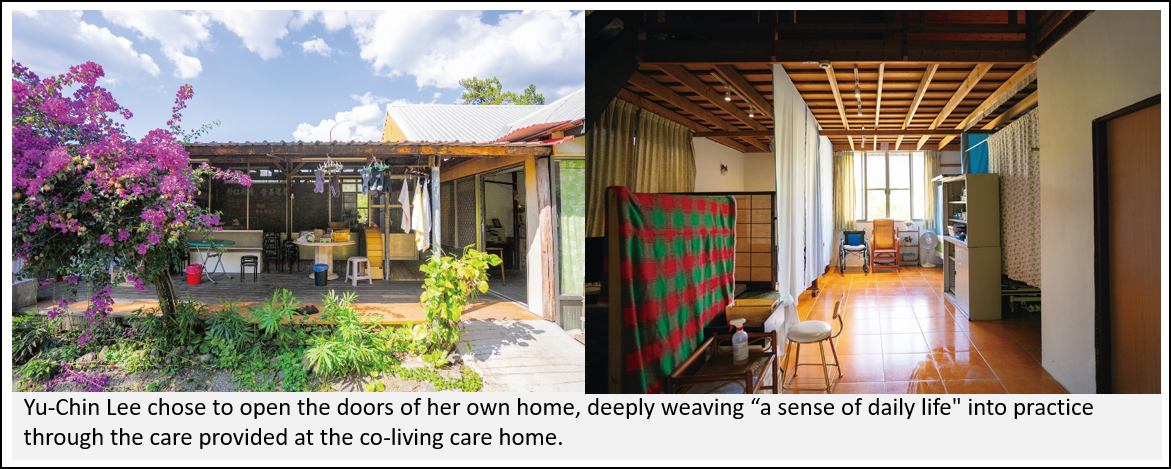
Therefore, after retirement, Lee did not leave this issue behind. Instead, she became even more directly involved. When Long-Term Care 1.0 was just beginning, she chose the most direct way to respond to the need—she opened the doors of her own home. There was no complicated design or system. In her home, elders in the tribe who needed care gathered together. Beginning with the basics—companionship, meals, and everyday activities—she gradually brought care back into daily life.
Continuing the Rhythm of Life: Bringing Care Closer to Everyday Life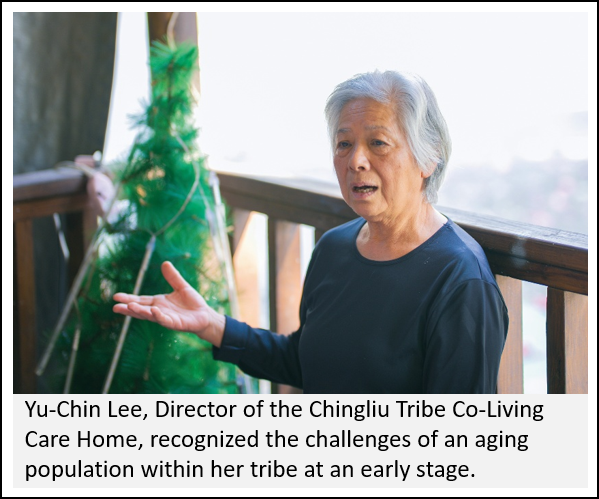
"Back then, the elders I encountered were usually already very frail," Lee reflects, a hint of sorrow in her voice. "Care always seemed to arrive too late. If we could intervene earlier, offering support while the elders still retain their independent living skills, perhaps the outcome would be different."
Through this continuous process of trial, error, and practice, the "co-living care home" gradually became Lee's direction for caregiving. Here, care is no longer simply an arranged process; it returns to life itself. Everyone eats together, chats together, and interacts in familiar language, while daily life continues at its original pace. This kind of environment has also allowed some situations once considered difficult to take on a different appearance.
"We once had a family member come to the Chingliu Tribe Co-Living Care Home whose family felt embarrassed to tell us that, at home, he often played with his own feces," Lee says with a smile. "At first, I was also very worried. But our concerns turned out to be unnecessary, because he has never exhibited this behavior here."
Puzzled by this, Lee gradually worked through the possible reasons and eventually found the answer. "Here, someone is present around the clock. When he has a bowel movement, we take care of it immediately. But before, he was often alone. His needs were not being noticed, so he could only express his discomfort in the most direct way."
When someone is present to accompany a person and respond to their needs, behaviors that were once seen as troubling can gradually disappear. Lee explains that the true meaning of a co-living care home "is not about providing more services, but about bringing care back to everyday life in a way that is closer to people." When people can live in familiar surroundings and be seen and responded to by people they know, growing old does not require them to adapt to a completely new life. It simply becomes a continuation of the life they have already been living.
Returning Care to the "Source of Life"
Whether it is witnessing how "home" can be refashioned in Wenshan, understanding how a "safety net" operates in Dongshi, or feeling the deep peace of "aging on one's own land" in the Chingliu Tribe, the co-living care home model is not a rigid template, but an evolving practice of communal living.
It allows care to move beyond simply being an arrangement of systems and resources, returning instead to the most fundamental question of everyday life: As a person gradually enters the later stage of life, can they still be understood, needed, and gently supported within the familiar language, relationships, and land that have shaped their lives?