
Over the past five, ten, and twenty years, an enormous amount of work has been devoted to developing public health palliative care as a distinct domain within palliative care. This movement began with the publication of Allan Kellehear's Health Promoting Palliative Care in 1999, followed by Compassionate Cities in 2005. Both books are built on a simple yet innovative and mobilizing idea: dying is a social event with a medical component—not a medical event with a social component.
However, the way many societies have developed and implemented palliative care suggests the opposite. Almost exclusive attention has been given to expanding professional palliative care services, while community-based approaches and societal capacity have been largely neglected by policymakers. As palliative care has become increasingly professionalized and medicalized, communities have had less and less involvement in the dying process. In response to these trends, Kellehear's books focus on applying health promotion methods to palliative care and on mobilizing social networks around people facing serious illness, loss, and death.
These ideas quickly spread across the globe, and since then, the field of Public Health Palliative Care has continued to mature. This is reflected in the worldwide compassionate communities movement, the biennial World Conference on Public Health Palliative Care, the creation of the specialized journal Palliative Care and Social Practice, the establishment of Public Health Palliative Care summer schools, the publication of textbooks, the founding of Academic Centres of Expertise on Compassionate Communities, and, last but not least, the creation of the international association Public Health Palliative Care International (PHPCI) – https://www.phpci.org
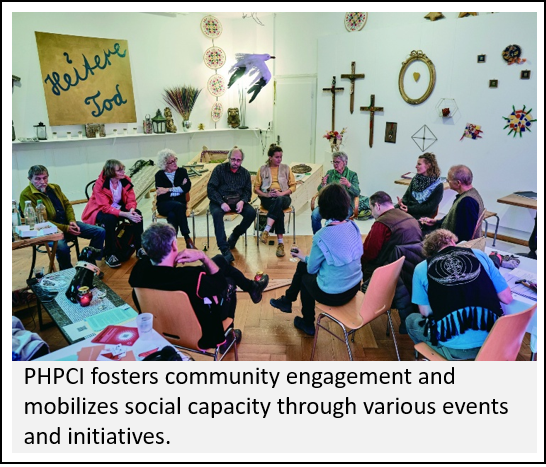
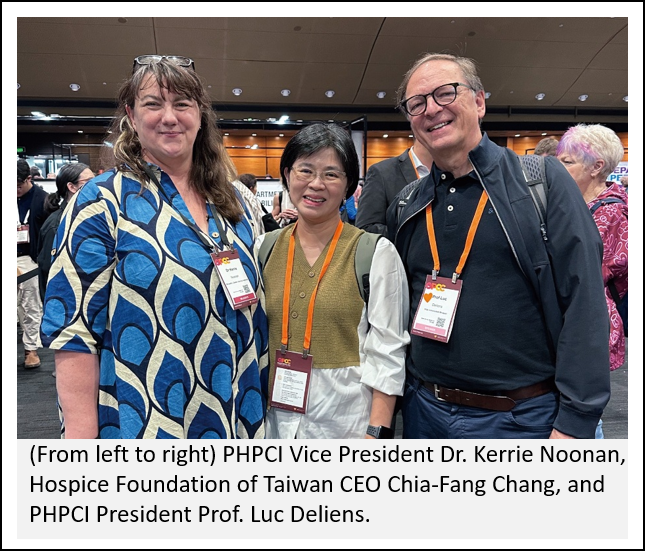
PHPCI views death, dying, loss, and care as everyone's responsibility—at least for those with the capacity to participate. A public health approach to end-of-life care sees the community as an equal partner in the long and complex task of providing high-quality care at the end of life. All PHPCI members hold this principle as true and commit their respective organizations to this shared vision. The association was inaugurated during the 3rd International Conference on Public Health and Palliative Care in Limerick, Ireland. Its mission is to promote public health principles and approaches in palliative care on a global scale by encouraging practice-based learning, providing professional support, and facilitating local and international communication between members working to embed public health perspectives into palliative care practice.
Our upcoming 9th International Conference on Public Health and Palliative Care, to be held 6-9 October 2026 in Taipei, Taiwan, presents a major opportunity to engage with Asia and support initiatives in Taiwan and beyond. This conference will promote the philosophy, values, concepts, and methods of compassionate communities, and help equip people with the educational and practical resources they need to advance the goals of health-promoting palliative care.
※Conference Information & Key Dates
Join us in Taipei for the upcoming 9th International Conference. For more details and participation, please visit our official website: PHPCI 2026
